As an institution that is deeply committed to society, CEU considers it fundamental that transparency and good governance criteria be used in the day-to-day running of the institution and its associated centres. Both are considered essential values for the proper functioning of both public and private institutions.
Entry into effect of Spanish Act 19/2013, of 9 December on transparency, access to public information and good governance, is a step in the right direction in the normative regulation of this field.
SAN PABLO CEU UNIVERSITY FOUNDATION would like to use this section to demonstrate its commitment to transparency and good governance. To this end, it will periodically publish and update information in accordance with its legal obligations but also other information of interest on the values that inform its goal of becoming a truly innovative, transparent and open organisation that is deeply committed to the society in which it operates.
Anuncio de la fusión por absorción entre la Fundación Universitaria San Pablo-CEU (fundación absorbente) y
la Fundación San Pablo para Ayuda al Estudio (fundación absorbida)
Más información
Purchasing procedure
San Pablo CEU University Foundation has an established procedure for regulating purchases with the aim of offering all its suppliers and contractors the security and guarantees needed to participate in these processes.
This management model complies with the guidelines established to ensure San Pablo CEU University Foundation follows the established policies on Quality, Ethics and the Environment.
The process for purchasing and contracting goods and services has the following stages:
- 1. Purchase application and schedule: the centre/ department that requires the goods or service notifies the purchase department, providing the information with the required specifications.
- 2. Supplier selection: the database of approved suppliers is checked to ensure the supplier has the required qualification for the goods or service needed.
- 3. Bid/tender process: process whereby a request for a proposal is issued to suppliers that have already been selected. The bid request is made in accordance with a specifications document in which the required specifications are defined.
- 4. Examination of tenders and award: the proposals received are assessed in terms of the established requirements (technical, financial and administrative) and the supplier(s) deemed to best meet the needs of San Pablo CEU University Foundation are then awarded.
- 5. Formalisation: once the award is made, the relationship between San Pablo CEU University Foundation and the supplier is formalised through Contracts, Agreements or Framework Agreements that are regulated by the General Contracting Conditions of San Pablo CEU University Foundation.
- 6. Order processing and management: order processing is monitored to ensure compliance with the technical specifications and required qualities.
The intention of San Pablo CEU University Foundation is that suppliers are afforded equal opportunities in the qualification and tendering processes, thereby favouring diversity and transparency in procedures.
Providers approval
To ensure transparency in processes and equal opportunities San Pablo CEU University Foundation has established processes for the registration, classification and selection of suppliers in accordance with objectivity and impartiality criteria.
Advertising and free competition is encouraged in the selection processes, within the boundaries of management efficiency criteria.
San Pablo CEU University Foundation uses the following questionnaire to register companies interested in initiating the qualification process and becoming possible suppliers. However receiving the completed questionnaire does not constitute any commitment.
Said questionnaire should be sent to the following address: [email protected]
San Pablo CEU University Foundation is committed to establishing confidence and good relations with its goods and services suppliers through a framework of collaboration and mutual respect that facilitates strong and enduring trade relations. The aim is to continuously improve purchasing and contracting processes in our quest for excellence.
Policy for Selection and Contracting of Persons
La CEU Selection Policy is based on a set of Principles used for all the selection processes in our Centres. These Principles are inspired by Values that define CEU in all its Excellence: Quality, Transparency, Objectivity and Meritocracy and these are organised as follows:
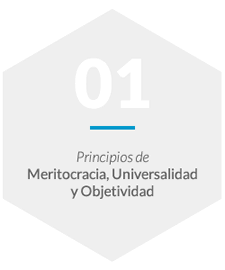
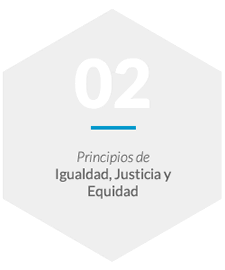
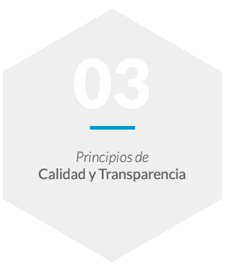
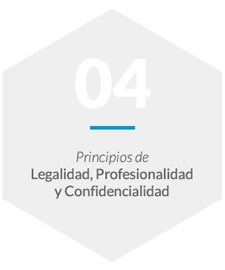
Generally speaking, the Selection Policy is based on a series of recognised practices used to Evaluate Individuals in the context of the workplace. These practices include:
- A management system to consolidate compliance with Data Protection Act (LOPD 15/1999).
- Incorporation of an access protocol for professions and/or activities that involve regular contact with minors, in compliance with Act 26/2015, of 28 July, amending the child and adolescent protection system.
- Advertising and broadcasting of vacancies, following transparency and universality criteria.
- Internal advertising of vacancies, to favour horizontal and vertical mobility of CEU employees.
- Appropriate candidacy competition in processes, to facilitate the selection of the best candidate.
- Full and objective evaluation of the candidate (technical, behavioural and language), following merit-based standards such as qualifications, abilities, knowledge and competencies, as well as ability to adapt to environment.
- Training of assessment staff and use of tested evaluation tools and techniques, meaning that decision-making is driven by formal rules that minimise subjectivity.
- Design of the Selection System following quality standards, defining procedures, describing processes and assigning responsibilities in each stage of the selection processes.
The main focus of the Objectives of the CEU Human Resources department is its search for the best professionals with language skills and a global outlook that are competent with new technologies and whose values are in tune with those of our institution.
These Objectives are compliant with the second priority of the 2014-2016 Action Plan: supply the Institution with an excellent high performance team that is motivated and shares the Foundation's mission, enabling it to become one of Spain's top education and training providers and expand internationally.
On an operational level, CEU's General Contracting Process defines criteria, guidelines and decision-makers in the selection processes and affects all the Centres and groups. This process is structured on the following points:
- Determination of need.
- Description of the vacancy and definition of the evaluation criteria.
- Advertisement of the job offer, internally and externally.
- Evaluation.
- Selection decision.
- Incorporation and welcoming of the new employee.
Under this general framework specific selection procedures have been developed for specific groups or Centres where required. Thus, three specific procedures are applied to centres and groups where needed, based on individual requirements. These are:
- Teaching and research staff Selection and Contracting Procedure CEU San Pablo University..
- Teaching and research staff Selection and Contracting Procedure in CEU Cardenal Herrera University.
- Teaching and research staff Selection and Contracting Procedures in CEU Abat Oliba University.
In conclusion, CEU's Staff Selection System aims to attain the aforementioned Objectives, facilitating the optimum development of staff selection processes, adapting to the principles outlined and emerging socio-educational needs and strengthening alignment with our values and ideology.
Governance Rules
San Pablo CEU University Foundation aims to fulfil the apostolic aims of its founding organisation, the Catholic Association of Propagandists, through the work it promotes and manages. As an ecclesiastical organisation, the Catholic Association of Propagandists aims not only to achieve its aims but also to do so through the use of decision-making structures and procedures that reflect its Christian ideology.
These Internal Governance Rules aim to help San Pablo CEU University Foundation to better meet its foundational aims.
The CEU is a non-profit educational and charitable institution, committed since 1933 to society, to the planet and to the future. At the CEU we have been promoting initiatives for the development and advancement of society for almost a century, directing our efforts towards the common good, seeking to establish the foundations for a humanistic economy. In these efforts, the Teachings of the Catholic Church has inspired and continues to inspire the CEU in its work to promote a model of development that respects people and the environment, in which the fundamental virtues are at the core of the economic paradigm.

GOOD Health and Well-Being
3rd IN SPAIN
118th WORLD POSITION
At the CEU we construe sustainability as the adaptation of the rates of extraction, production and consumption of resources to the speed of their regeneration. A system is sustainable when the rate of extraction, production and consumption of resources is equal to or less than their rate of regeneration. For the CEU, the promotion of sustainability involves making a number of assumptions:
- Sustainability is developed under the pillars of a free market economy. Neither interventionism nor the planned economy are necessary factors or models; sustainability is possible within the framework of the free market economy thanks to production and consumption models such as the circular economy.
- People, not environmentalism, are at the centre of the paradigm. On the one hand, because "in development initiatives, the principle of the centrality of the human being, who is the primary bearer of the duty of development, must be preserved. What matters most is the improvement of the living conditions of individual people [...]" (Benedict XVI). On the other hand, because the reason for preserving natural resources is not to slow down the progress and development of humanity, but to ensure that we do not destroy the source of resources we are given to fulfil our human yearning to build, improve and progress.
- “For the human family, our home is the earth, the environment that God the Creator has given us to inhabit with creativity and responsibility. We must care for the environment: human beings have been entrusted to care for it and cultivate it with responsible freedom, always having the good of all as our guiding criterion”. (Benedict XVI)
- Sustainability transforms, but does not annul, the accumulation of goods, which ceases to be seen as an accumulation for the present and becomes a duty of responsibility towards others: previous generations (past), who left the resources that today are a source of wealth, and future generations (future), who must also be able to enjoy those same resources.
- Sustainability transforms, but does not annul, the concept of economic freedom and enterprise, which is no longer understood as the ability to obtain maximum profit, maximum utility, and the maximum sum of total goods for the organisation or for me as a consumer (libertarianism), but rather as an external commitment to others (common good).

Putting an end to hunger, safeguarding our planet's resources, building fair societies, guaranteeing equal opportunities... The great global challenges we face are many. This page is a sample of CEU's mission and its efforts to achieve sustainability faithful to the Teachings of the Catholic Church and in line with five of the seventeen Sustainable Development Goals proposed by the United Nations.
THE's Impact Ratings 2026

 SDG 3 GOOD HEALTH AND WELL BEING
| SDG | METRIC/INDICATOR | DESCRIPTION | EVIDENCE |
| 3.3 | Collaborations and health services | ||
| 3.3.1 | Current collaborations with health institutions | The highlighted section of the document shows a list of outreach programs for the local, national and global community to promote health and wellbeing, including hygiene, nutrition, sports, exercise, healthy aging and other topics connected to health and wellbeing. | Evidence 3.3.1 |
| 3.3.2 | Health outreach programmes | Report on the Project for inclusion in the Spanish Network of Healthy Universities, approved by the Ministry of Health, Social Policy and Equality. | Evidence 3.3.2 |
| 3.3.3 | Shared sports facilities | CEU Universities have sports facilities that can be accessed for free by members of the local community (tennis, paddle and sports court) accompanied by a CEU community member. Local community members may also participate for free in sport activities organized by CEU Universities out of their facilities, such as canoeing, archery, climbing, etc. | Evidence 3.3.3 |
| 3.3.4 | Free sexual health care for students | Evidence shows that, based upon the notion of sexuality and sexual healthcare that is proper to Anthropological realism, which underlies the Catholic understanding of the human being (CEU Universities are faithful to their Catholic identity), we do provide free healthcare and sexual healthcare to our students, including information and education services. | Evidence 3.3.4 |
| 3.3.5 | Mental health support | The highlighted section of the evidence and the 2024-25 annual report of the University Psychologist office, confirm that CEU Universities provide students and staff with access to mental health prevention and support. CEU Universities, for that purpose, count on teams of Psychologists in each University that, for free, provide mental health services to students, faculty and staff who may request them | Evidence 3.3.5 |
| 3.3.6 | Smoke-free policy | CEU Universities have a "smoke-free policy" | Evidence 3.3.6 |
| 3.3.7 | Mental health support for staff | Evidence shows that CEU Universities prioritize the well-being of their staff by offering a comprehensive mental health plan, available to employees and their immediate family members. This plan provides essential support for addressing and overcoming various life challenges that may impact psychosocial health. The plan was developed based on the findings of the psychosocial risk study conducted at CEU in previous academic years | Evidence 3.3.7 |